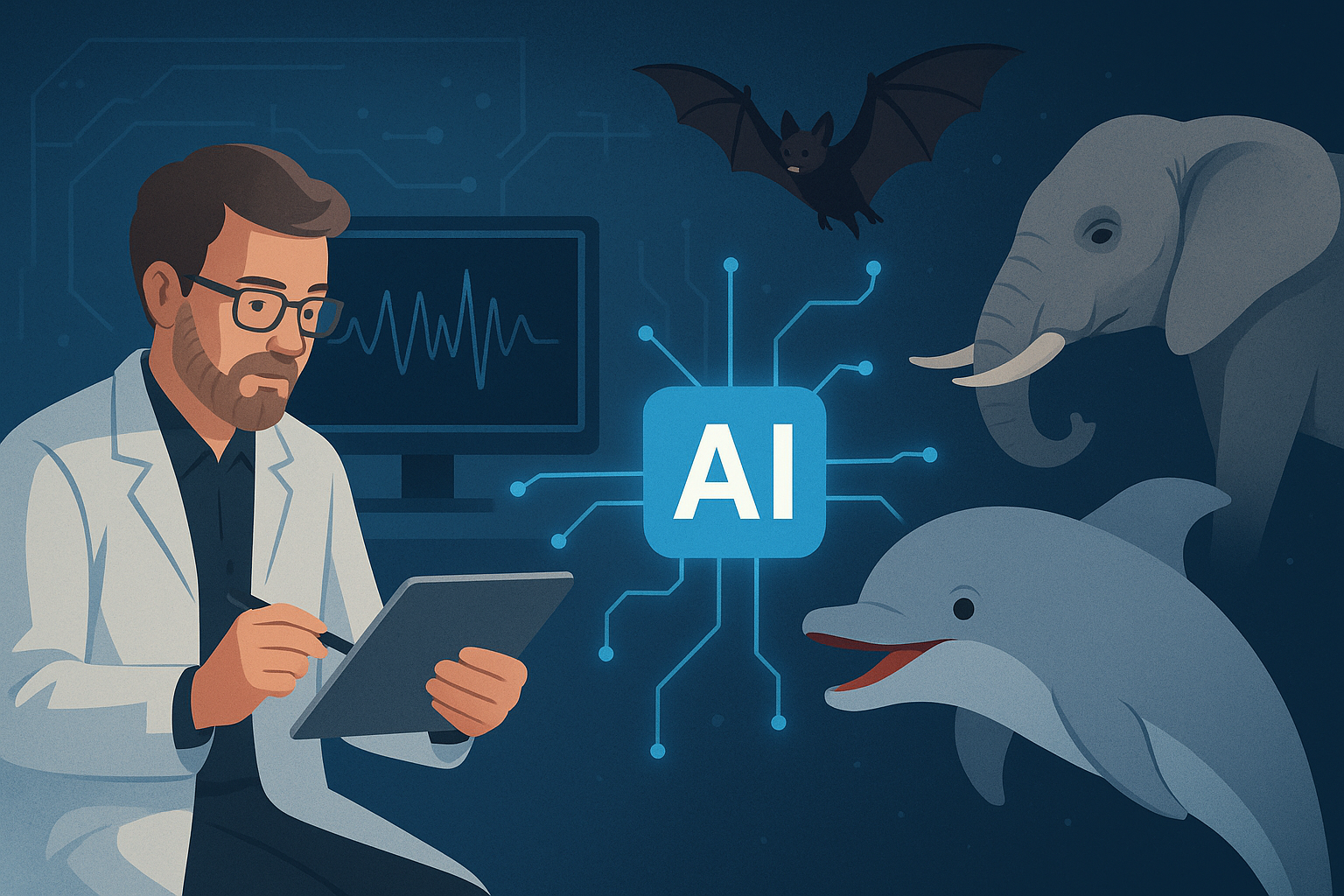
Artificial Intelligence (AI) is no longer limited to human communication — it’s now venturing into the mysterious world of animal languages. From decoding dolphin clicks to understanding elephant rumbles, AI is being trained to translate what animals might be saying. While this idea once belonged to science fiction, researchers today are turning it into a fascinating reality.
In this article, we’ll explore how AI is helping decode animal communication, the latest breakthroughs, and what the future might look like when humans can “talk” to animals.
The Rise of AI in Animal Communication
For centuries, humans have tried to interpret animal behavior — through sounds, gestures, and instincts. But AI has added a scientific edge to this curiosity. Using machine learning, neural networks, and sound pattern recognition, scientists are now able to analyze thousands of animal vocalizations and identify patterns invisible to the human ear.
Projects like the Earth Species Project (ESP) and Project CETI (Cetacean Translation Initiative) are leading this revolution. Their mission is simple yet groundbreaking — to build AI models that can decode the language of non-human species, especially dolphins and whales.
“We are building tools to understand animal communication, not just mimic it,” says Aza Raskin, co-founder of the Earth Species Project.
How AI Models Decode Animal Sounds
The process of decoding animal communication involves several key steps powered by AI:
1. Data Collection
Researchers record animal sounds using underwater microphones (hydrophones), forest sensors, or drones. These devices capture hundreds of hours of natural calls, clicks, and songs.
2. Pattern Recognition
AI algorithms analyze these recordings and find repeating sound structures — similar to how AI models process human speech in tools like ChatGPT or Google Gemini.
3. Context Analysis
AI looks at behavioral data — for example, if a dolphin makes a certain sound before playing or hunting, that sound may represent a specific “word” or emotion.
4. Meaning Extraction
After millions of data points, AI predicts possible meanings — happiness, alert, hunger, or social signals — giving scientists an early “dictionary” of animal communication.
This combination of AI and bioacoustics is opening a new window into how animals think, feel, and connect.
Breakthrough Projects Around the World
Several global initiatives are now using AI to understand animal communication:
- Project CETI (USA): Focuses on decoding sperm whale clicks called codas using deep learning.
- Earth Species Project (Global): Uses open-source AI to analyze multi-species communication, including birds, elephants, and primates.
- DeepSqueak (University of Washington): Detects ultrasonic calls in rodents to study emotional states.
- Elephant Listening Project (Cornell University): AI listens to elephant rumblings to detect stress and migration behavior.
These projects use advanced AI language models, similar to those used in human text generation, but trained entirely on animal acoustic data.
Can Humans Really Talk to Animals?
While the idea of humans chatting with dolphins or elephants sounds amazing, experts warn it’s not that simple. AI can recognize patterns in sounds, but true translation requires understanding intent and context — something still beyond current models.
In most cases, AI can “interpret” meaning — like identifying danger calls, mating signals, or group coordination — but not conduct a two-way conversation yet.
Still, progress is steady. Some pet communication tools, like FluentPet, use AI and sound-button systems allowing dogs to “speak” simple phrases such as “play,” “outside,” or “love you.” These systems are still basic, but they show how AI may one day enable human-animal dialogue.
Ethical and Scientific Challenges
As AI gets smarter, scientists face important questions:
- Should we talk back to animals?
Sending signals back could confuse or disturb wildlife behavior. - Are we oversimplifying animal thoughts?
Translating their communication into human words might distort their meaning. - Who owns the data?
Wildlife sound recordings from endangered species must be ethically protected.
Experts emphasize that AI’s role should be to understand and protect animals, not to exploit them. This approach ensures that technological progress aligns with conservation and respect for other life forms.
The Future of AI-Driven Animal Communication
The future looks promising — imagine conservationists using AI translators to warn elephants about poachers, or marine biologists using real-time whale translators to avoid ship collisions.
With multimodal AI models becoming more powerful in 2025, it’s now possible to merge sound, video, and movement data to create richer interpretations of animal communication. AI could soon bridge the gap between species — turning empathy into technology.
AI-powered translation might also enhance wildlife protection, by predicting stress or migration patterns based on acoustic signals before any danger occurs.